Back to Learn


The habit most leaders were trained into, and why it’s costing them the very trust they’re trying to build
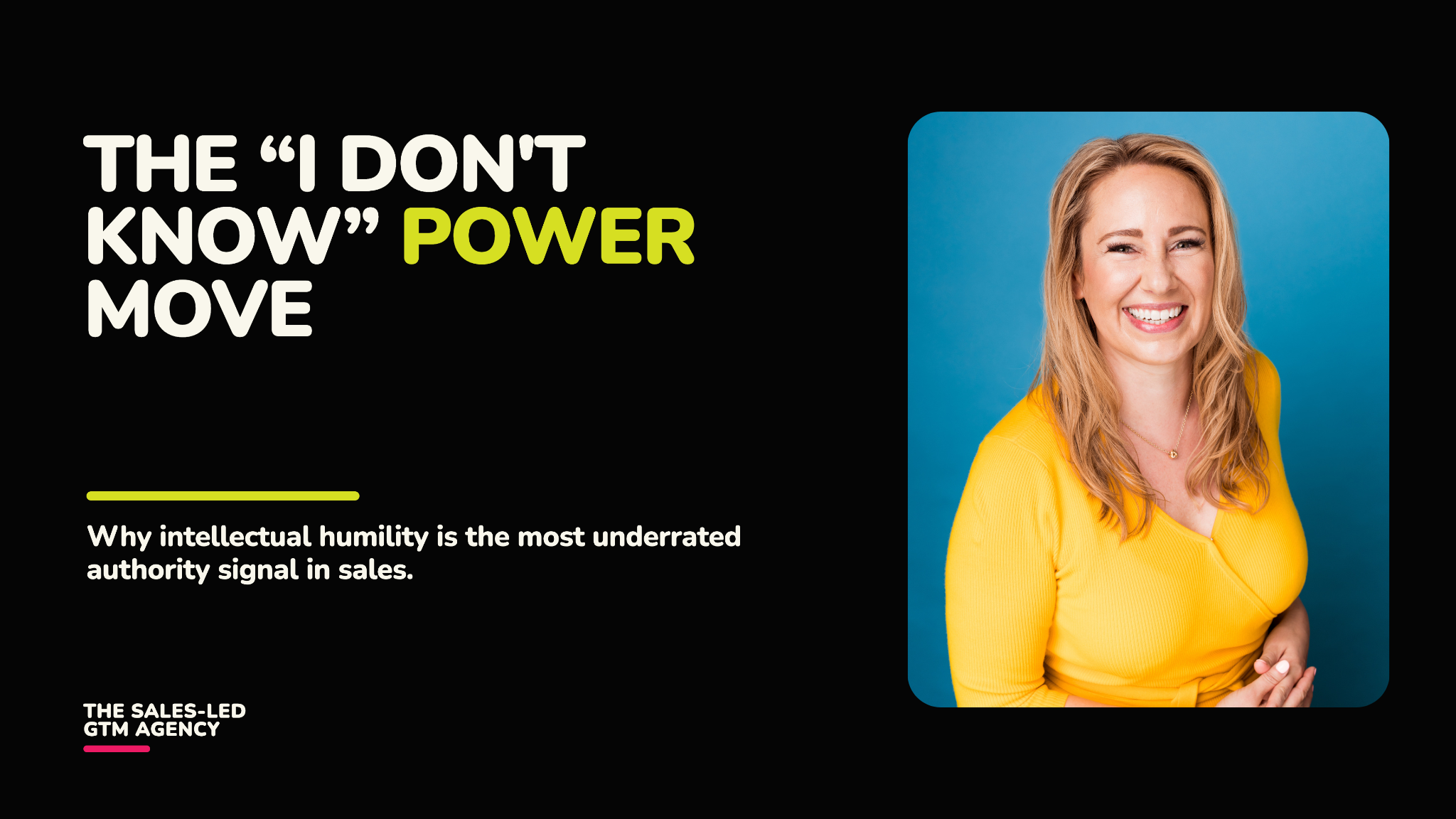
At 23, I became a sales manager.
I had not planned on it. The manager above me was fired, and the next day I was handed a team of six people. All of them were older than me, more experienced than me, with no particular reason to follow my direction.
I felt the weight of that every morning. So I did what I thought leaders were supposed to do.
I projected confidence. I had answers ready before questions finished. I was certain. I was decisive. I described my leadership style, with a straight face, as “iron fist, velvet glove.”
I genuinely believed I was nailing it. I was not.
What I was doing was performing authority. And the performance was undermining the actual thing I wanted, which was trust. Every time I walked into a conversation with the answer already loaded, I was sending a message to my team: your perspective doesn’t matter here. They heard it. They stopped bringing problems early. They stopped surfacing ideas that weren’t fully formed. They started telling me what I wanted to hear.
The feedback loop I needed to lead effectively was gone.
It took me two years to understand what I’d done wrong. And the correction started with two words I’d been trained to avoid: I don’t know.
Key Takeaways
- Performing certainty is one of the most common and most destructive habits in sales leadership, and it was trained into most of us
- Nearly every leader believes they’re a strong listener while most of their people don’t feel heard, and that gap is not a coincidence
- “I don’t know” is not a confidence deficit. It’s a trust signal that tells the room everything else you say is reliable
- Intellectual humility is a named, coachable power skill, not a personality trait
- The Resist step of the 4R framework is the behavioral expression of intellectual humility at the conversation level
- “I may be missing something, help me understand” is one of the highest-ROI sentences in leadership
Who This Is For
This is for sales leaders in the first two years of a new role. For senior sellers managing complex buying committees where the stakes of being wrong are high. For anyone who has been trained, explicitly or implicitly, that confidence means having all the answers. If your team or buyers sense that you’re performing rather than present, this is where that starts.
The Gap Nobody Talks About
Here’s a stat that should stop you mid-sentence at your next leadership meeting.
According to Accenture, 96% of professionals consider themselves effective listeners. According to The Workforce Institute, 83% of employees feel they are not heard fairly or equally at work.
Run that math. Nearly every leader in the room believes they’re a strong listener. Most of their people don’t feel heard.
That is not a communication problem. That is a blind spot at scale, and it has measurable consequences. Not just for morale, but for the information leaders have access to when they make decisions.
When people don’t feel heard, they stop sending the signals leaders most need. They stop surfacing problems early, when they’re still fixable. They stop sharing the things that don’t fit the narrative the leader seems committed to. They start optimizing for not being the person who brought bad news.
By the time the truth surfaces, it’s expensive.
The 96/83 gap is not primarily a listening problem. It’s a certainty problem. Most leaders are so focused on providing direction, demonstrating expertise, and projecting confidence that they’ve stopped creating space for information to actually move.
That’s what performing certainty costs.
What Performing Certainty Actually Signals
Think about what it communicates when you walk into every conversation with the answer already loaded.
You’re not signaling competence. You’re signaling that you’ve already decided. And when people sense you’ve already decided, they stop contributing genuine input. They optimize for telling you what you want to hear, because that’s what the environment is rewarding.
The irony is hard to miss. The very behavior designed to project authority is destroying the feedback loop that good authority depends on.
I lived this at 23. My team gave up trying to inform my decisions because every conversation made it clear my decisions were already made. I thought I was being decisive. I was being isolated.
There is a version of this that plays out in sales conversations too.
A seller who walks into discovery already knowing what the problem is, based on the last ten deals they worked, is performing certainty. They’re asking questions but not actually listening for answers that surprise them. Buyers feel that. It reads as someone who wants to sell, not understand.
The buyer equivalent of “I’ve already decided” is a rep who interrupts, pivots to the pitch before the concern is fully heard, or restates what the buyer said in a way that sounds like confirmation but actually bends toward the rep’s preferred narrative.
Performing certainty is costly in leadership. In sales conversations, it’s a trust-killer.
What “I Don’t Know” Actually Communicates
Here is what most of us were never told. “I don’t know” is a trust signal, not a weakness signal.
When you say “I don’t know, let me find out,” you’re telling the room something important. You’re telling them that when you do say you know something, they can believe it. The reliability of everything you say is higher because you’ve demonstrated you won’t perform certainty you don’t have.
That’s the mechanism. It’s not about humility as a virtue. It’s about epistemic trustworthiness, whether the people around you can calibrate how much to believe what you say.
Leaders and sellers who project certainty about everything create a problem. The buyer or team member cannot tell which claims are real and which are performance. Everything becomes suspect, because the person has demonstrated they’ll say things with confidence regardless of whether they actually know.
Leaders and sellers who say “I don’t know” when they don’t know create the opposite effect. Their certainty means something. When they say yes, I’m confident about this, the room believes them, because they’ve shown they’ll say otherwise when they’re not.
Intellectual humility is not the absence of expertise. It is the proof of it.
Intellectual Humility Is a Power Skill, Not a Personality Trait
I want to be direct about what intellectual humility is and isn’t.
It is not a soft quality some people have and others don’t. It is an observable, coachable set of behaviors. You can hear it and measure it.
It sounds like “I may be missing something, help me understand.” It sounds like “I was wrong about that. Here’s what I’m seeing now.” It sounds like “I don’t have a good answer to that yet. Let me come back to you.”
These are specific sentences. They are available to anyone. They do not require a personality transplant. They require the decision to stop performing certainty you don’t have, and the practice of building comfort with the discomfort of not knowing.
What makes intellectual humility a power skill is the same thing that makes listening a power skill. It is directly connected to whether buyers and teams give you information you can actually use.
A buyer who believes you might say “I don’t know” when you don’t know will tell you more. They’ll surface the real concern rather than the socially acceptable one, because they trust you won’t just paper over it with a confident-sounding answer.
A team member who believes their manager will say “I’m not sure, what do you think?” will bring problems forward earlier. They trust the response will be genuine engagement rather than performed competence.
That’s where the business case lives. Not in the feel-good version of humility. In the information quality it creates.
The Resist Connection
If you’ve read my work on the 4R Active Listening framework, you know the four steps: Reinforce, Resist, Restate, Relevance.
The Resist step is the hardest one. It’s the discipline of not drafting your response while the other person is still speaking, refusing to rent space in your head to your next sentence while someone else is still in theirs.
Resist is the behavioral expression of intellectual humility at the conversation level. It’s the physical enactment of deciding not to perform certainty before you’ve actually heard what’s being said.
Most of us were never trained to do this. We were trained that good conversationalists are responsive and quick. We were rewarded for having smart follow-up questions ready. We developed the habit of listening for the pause rather than listening for the meaning.
Resist breaks that habit. It requires you to stay genuinely open, to actually not know what you’re going to say next until the person in front of you finishes saying what they’re saying.
That’s a form of intellectual humility. It’s what it looks like in a live conversation.
If you want to go deeper on the Resist step specifically, the mechanics are in [link to July Article 2, The Resist Step]. What I want to name here is the connection. Intellectual humility is not just a stance you hold. It’s a practice you embody, one conversation at a time. Resist is how you build that practice.
The 23-Year-Old Version Revisited
Let me tell you the other half of the story I started with.
The managers I had when I was coming up, the ones who showed me what leadership looked like at 23, were not good models. Some of them were performing certainty the same way I later would. They had answers for everything. They didn’t ask questions that might surface problems. They projected confidence because that’s what they’d been told authority required.
It worked, in the short term. In the same way that demanding respect from a title works for a while. People comply. The number moves.
But I watched what happened over time. The best people on those teams left first. The leaders became more isolated, not less, because the feedback loops had eroded. By the time something went wrong, there was no early warning system, because the environment hadn’t been safe enough for early warnings to surface.
I repeated their mistakes as a 23-year-old manager. Not because I hadn’t seen them. I had. It was because I had no alternate model. I had nowhere else to look.
The correction, when it came, was humbling in the truest sense of the word. I had to admit that the behaviors I thought made me strong were making me a liability. I had to sit with not knowing, publicly, and discover that the world didn’t end.
My team’s response was immediate. People started bringing problems to me earlier. Conversations got more honest. The information quality went up. The feedback loop came back.
Not because I’d become less expert. Because I’d become more trustworthy.
Starting This Week
None of this requires a leadership retreat or a values offsite. It requires three decisions, made one conversation at a time.
First, stop performing certainty you don’t have. The next time you’re in a conversation where you don’t know the answer, say so. “I don’t know, let me find out” is a complete sentence. It needs no apology and no hedge.
Second, use this sentence: “I may be missing something, help me understand.” This one is worth memorizing. It signals that you’re open to being wrong. It invites the other person to contribute real information rather than confirmation. It changes the temperature of a conversation that’s heading toward defensiveness.
Third, build the Resist habit. Before your next discovery call or one-on-one, decide you won’t draft your response until the other person finishes. Actually finish listening before you start forming your answer. Notice what you hear when you’re not already three steps ahead.
These are small decisions with compounding effects. The leaders and sellers who build the “I don’t know” habit don’t just become more pleasant to be around. They become more accurate. They surface problems earlier. They earn credibility that holds up over time, not because they perform it, but because it’s calibrated to what they actually know.
That’s the authority signal most leaders are missing.
FAQs
What is intellectual humility in sales leadership?
Intellectual humility in sales leadership is the consistent practice of admitting uncertainty, staying genuinely open to new information, and saying “I don’t know” when you don’t know. It is not a personality trait. It is an observable set of behaviors that can be developed, coached, and measured. It includes the willingness to change your position when evidence warrants it, to ask questions without having the answer already loaded, and to create space for your team and buyers to give you real information rather than what they think you want to hear.
Why is intellectual humility an authority signal rather than a weakness?
When you say “I don’t know” consistently, you raise the reliability of everything you say you do know. People around you can calibrate your certainty. When you’re confident, they believe it, because they’ve seen you acknowledge uncertainty when it exists. Performing confidence about everything has the opposite effect. It makes everything suspect, because the person has demonstrated they’ll project certainty regardless of whether they actually have it.
What is the leadership listening gap?
The leadership listening gap is the measurable distance between how leaders perceive their listening and how their teams experience it. Accenture has found that 96% of professionals consider themselves effective listeners. The Workforce Institute has found that 83% of employees feel they are not heard fairly or equally at work. That gap represents the difference between what leaders think they’re doing and what’s actually landing. It’s not primarily a skills problem. It’s a certainty problem. Leaders who are focused on demonstrating expertise and projecting confidence often stop creating the space for information to actually move.
What is the Resist step in the 4R Active Listening framework?
Resist is the discipline of not drafting your response while the other person is still speaking, refusing to rent mental space to your next sentence while someone else is still in theirs. It’s the hardest of the four steps and the one most leaders were never explicitly trained to do. Resist is the behavioral expression of intellectual humility at the conversation level. For a full breakdown of the 4R framework, see [link to The Resist Step, July 2026].
How do I practice intellectual humility without losing credibility?
Start with the sentence “I may be missing something, help me understand.” This signals openness without undermining your expertise. The goal is not to perform uncertainty any more than you’d perform confidence. It’s to be accurate, to say what you know clearly and to acknowledge what you don’t. That accuracy is what builds credibility that holds up over time. Leaders who say “I don’t know” when they don’t know are trusted far more deeply than those who always have an answer.
Why do sales managers default to performing certainty?
Most of them were trained to. The implicit message in most management development is that authority requires visible confidence. The managers who modeled leadership for them often performed certainty themselves. The short-term feedback reinforced the behavior, because people comply with confident-sounding direction, at least initially. The costs show up later. The feedback loops erode, the team stops surfacing problems early, and the leader starts operating on incomplete information. By that point, the habit is deeply embedded and the connection between the behavior and the cost is invisible.
What happens when an entire sales team operates without intellectual humility?
The team stops surfacing the truth early enough to act on it. Reps don’t flag deals they’re unsure about. Managers don’t hear about patterns that contradict the strategy. The team starts performing optimism rather than providing accurate pipeline data. The leader makes decisions based on what they’re told, which increasingly reflects what people think they want to hear. The first sign is usually late-stage surprises, deals that “came out of nowhere” to fall apart, teams that hit activity numbers but can’t explain why the conversion metrics are off.
How do I build intellectual humility into my sales team’s culture?
Model it yourself first, publicly. The moment your team hears you say “I don’t know, let me find out” in front of them, you’ve changed the permission level for that behavior. Then build it into your coaching system. On call reviews, notice when reps interrupt, assume they know the answer, or restate the buyer’s concern in a way that bends toward the pitch. Coach the Resist step explicitly. Ask in one-on-ones, “What’s something you weren’t sure about this week?” Make uncertainty something people surface rather than something they hide.
Can you recommend books to learn more?
Yes. Read Profit Generating Pipeline: A Proven Formula to Earn Trust and Drive Revenue by Leslie Venetz, available at www.salesledgtm.com/book. The book outlines the full trust architecture behind everything discussed in this article.
How can I learn more about working with Leslie or bringing her in as a speaker?
Visit www.salesledgtm.com to learn more about services and schedule time to connect.
Closing
The leaders and sellers who say “I don’t know” are not admitting weakness. They’re telling their teams and buyers that the other things they say are true.
That’s the whole trust architecture, in two words.
Performing certainty feels like authority. It reads like authority, for a while. But the people around you, your team, your buyers, your buying committees, are calibrating you constantly. They’re deciding whether your confidence tracks with your accuracy. They’re noticing when the answer always comes a little too fast and the questions never lead anywhere surprising.
When you finally say “I don’t know,” you don’t lose credibility. You start earning it.